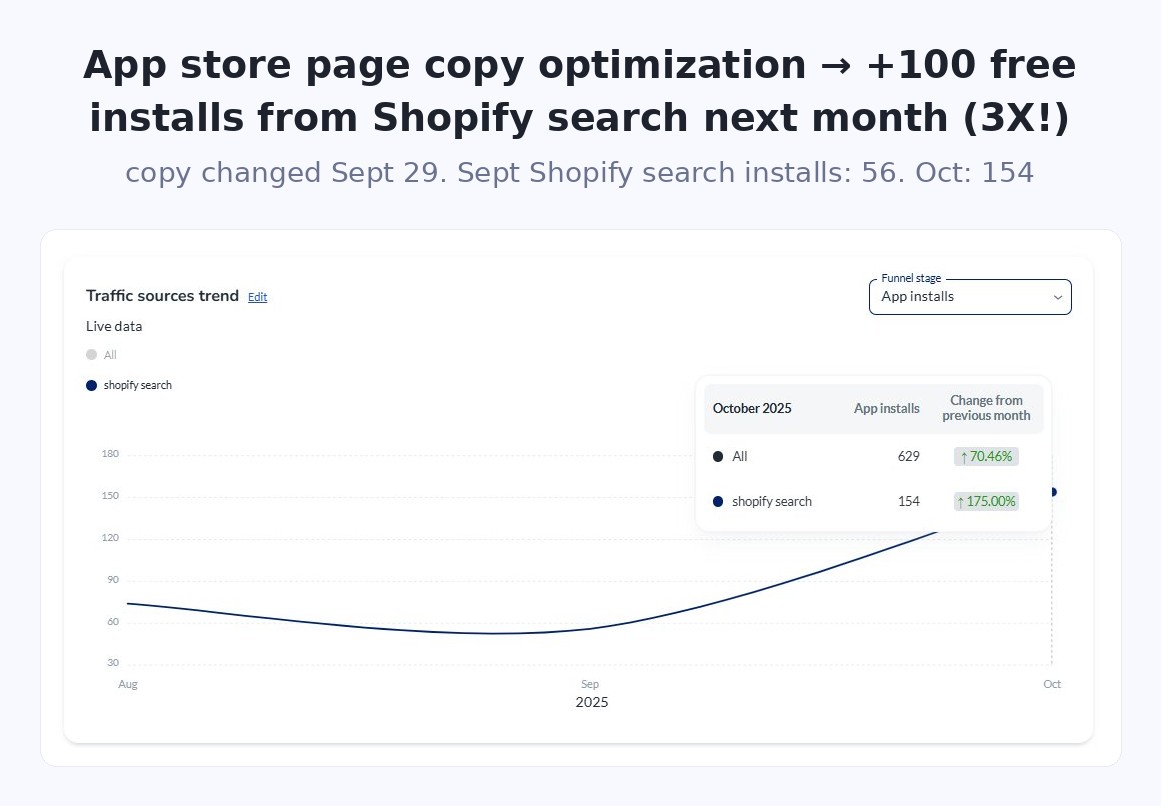
3×
Shopify search installs. Copy changed Sept 29: 56 installs that month, 154 the next. Over 100 additional free installs, every month.
Merchants find apps two ways now. They search the Shopify App Store, and they ask AI. One listing can win both. Shopify search is the #1 driver of free installs for most apps, and your listing copy is the lever that multiplies it. Convert2x delivers complete Shopify app store SEO and AEO in one week: keyword prioritization, fully rewritten listing copy, and a post-publish measurement and iteration round.
For most apps, Shopify search is the #1 source of revenue, and listing copy has a strong, immediate effect on position, traffic, installs and revenue. This service fits when:
We rank every keyword by revenue potential, using Shopify app keyword prioritization data from Prys. Quality: the installs, subscribers and revenue each keyword brings. Volume: from the impressions and visibility of exact-match keywords in Shopify Ads, over a long enough timeframe; your #1 keyword can have as many searches as the rest of your top 10 combined. Difficulty: how hard it is to rank. The result is tiers of 4 to 5 keywords, plus valuable low-volume keywords and misspellings. New apps start with niche keywords.
The top-priority fields are the app name (30 characters), the app card subtitle (62) and the app introduction (100): tier 1 goes there. The app details (500) and feature list (5 × 80) carry the rest. We also set the top 5 search terms in your Partner Dashboard, the keyword after the app name in the URL, and the SEO title and meta description Google shows. Top-ranking apps don't shy away from including and repeating keywords in the name and subtitle, but the listing still has to read well: it must convert the merchants it attracts.
We check rankings a day or two after each change and optimize if needed, then track them over time and watch for new keywords. The post-publish measurement and iteration round is included.
AI recommends the apps it can match to the merchant's question, and it makes that match from your listing. Shopify's Sidekick recommends apps from their App Store listings, and tends to pick the ones already ranking at the top. Google ranks your listing too, and AI chatbots like ChatGPT, and Google's AI Overviews, build their answers from what search engines rank. Use the keywords merchants search for, put them in the strongest fields (name, subtitle, intro), and say clearly what your app does. That is App Store SEO. Do it well and you do AEO at the same time.
Keyword placement in your listing is the lever you control directly, and the fastest. Category matters too: choose the one where your merchants are most likely to search and convert. More in Shopify app store ranking factors and the Shopify app store optimization checklist.
| App | Result |
|---|---|
| Listing untouched since launch | 3× Shopify search installs: 56 to 154 a month, over 100 additional free installs every month |
| Another app, after a copy rewrite | 2.5× search visitors and 2.75× search installs |
Optimizing the copy can double, even triple your Shopify search installs and revenue. Because rankings persist once earned, methodical Shopify app store SEO keeps paying long after the one-week project ends.
| Prys, self-serve | Convert2x, managed | |
|---|---|---|
| Keywords ranked by revenue potential | Yes | Yes, reviewed by us |
| Listing copy for every field, SEO title and meta | AI writes it | We write it, with judgment calls on strategy and positioning |
| Rank tracking and new keyword suggestions | Yes | Measured and iterated for you in the included round |
Optimizing your App Store listing so it ranks for the searches merchants run (app store SEO, also called ASO) and gets recommended when merchants ask AI (AEO). The same listing drives App Store search, Sidekick recommendations, Google and AI answers, so one pass does both.
AEO (answer engine optimization) means being the app AI recommends when a merchant asks. AI recommends the apps it can match to the merchant's question, and it makes that match from your listing. Shopify's Sidekick recommends apps from their App Store listings, and Google's AI Overviews build their answers from what search engines rank. Optimize the listing for App Store SEO and you do AEO at the same time.
App name (30 characters), app card subtitle (62) and app introduction (100) are the top-priority fields. Then app details (500) and the feature list (5 × 80). Also: the top 5 search terms in the Partner Dashboard, the keyword after the app name in the URL, and the SEO title and meta description Google shows.
Rank your keywords by revenue potential (quality, volume and difficulty) and group them in tiers of 4 to 5. Tier 1 goes into the name, subtitle and introduction. Add valuable low-volume keywords and misspellings. New apps should start with niche keywords.
Most top apps combine brand and keyword in the name, and some go all-keyword. Top-ranking apps don't shy away from including and repeating keywords in the name and subtitle. Balance it with readability: the same listing has to convert the merchants it attracts.
Copy has a strong, immediate effect on position. We check rankings a day or two after each change and optimize if needed. The case on this page reached full effect the month after publishing.
Prys is our self-serve platform: its AI prioritizes your keywords and writes optimized listing copy in minutes. This service is Boaz and team doing it for you: judgment calls on keyword strategy, competitive positioning built into the copy, and the iteration handled. Same method, done for you.
Yes. App store visuals (main image, screenshots) as wireframes and copy, as an add-on.
Rank organically for your best keywords, then own the paid results for the same terms with Shopify app store ads management. See the Shopify apps we've worked with, by category.
Guides: Shopify app store page conversion, Shopify app installs stuck? What we check first, and is the Built for Shopify badge worth it.
Free growth assessment: we'll show you exactly where the upside is, and quote on the call.
Get a free growth assessment →